> For the complete documentation index, see [llms.txt](https://docs.finandy.com/llms.txt). Markdown versions of documentation pages are available by appending `.md` to page URLs; this page is available as [Markdown](https://docs.finandy.com/es/trading/create-order-grid/order-types/limit-order.md).

# Orden Limit

Una orden limit es una orden de exchange que se crea a un precio fijo.

## Crear una orden

Para realizar una orden debe:

1. Seleccionar <mark style="color:green;">**"Nuevo Largo"**</mark> o <mark style="color:red;">**"Nuevo Corto"**</mark>
2. Introducir el precio ( por ejemplo - L)
3. Introducir el precio ( se puede hacer en el gráfico)
4. Introducir una cantidad o volumen
5. Y pulsar <mark style="color:green;">**"Abrir LARGO"**</mark>

<figure><img src="https://t24536365.p.clickup-attachments.com/t24536365/826a2192-1098-47fd-9ff0-bb3e26c18486/image.png" alt="" width="375"><figcaption></figcaption></figure>

Referencias relacionadas:

{% content-ref url="/pages/nRNdm6CZ7dxwnH8i5hB0" %}
[Volúmenes personalizables](/es/trading/create-order-grid/custom-volume.md)
{% endcontent-ref %}

Una orden limit puede colocarse en el libro de órdenes (creará liquidez) o ejecutar las ofertas de otros participantes, en función de los precios extremos del libro de órdenes y del precio de la orden limitada que se crea.

## Condiciones para colocar una orden limit en el libro de órdenes

{% hint style="info" %}
**Nota:** Los órdenes límite están sujetos a una restricción de desviación de precio respecto al precio actual del mercado (\~5-10%). Los órdenes con precios anormalmente altos o bajos serán rechazados automáticamente.
{% endhint %}

### Comprar

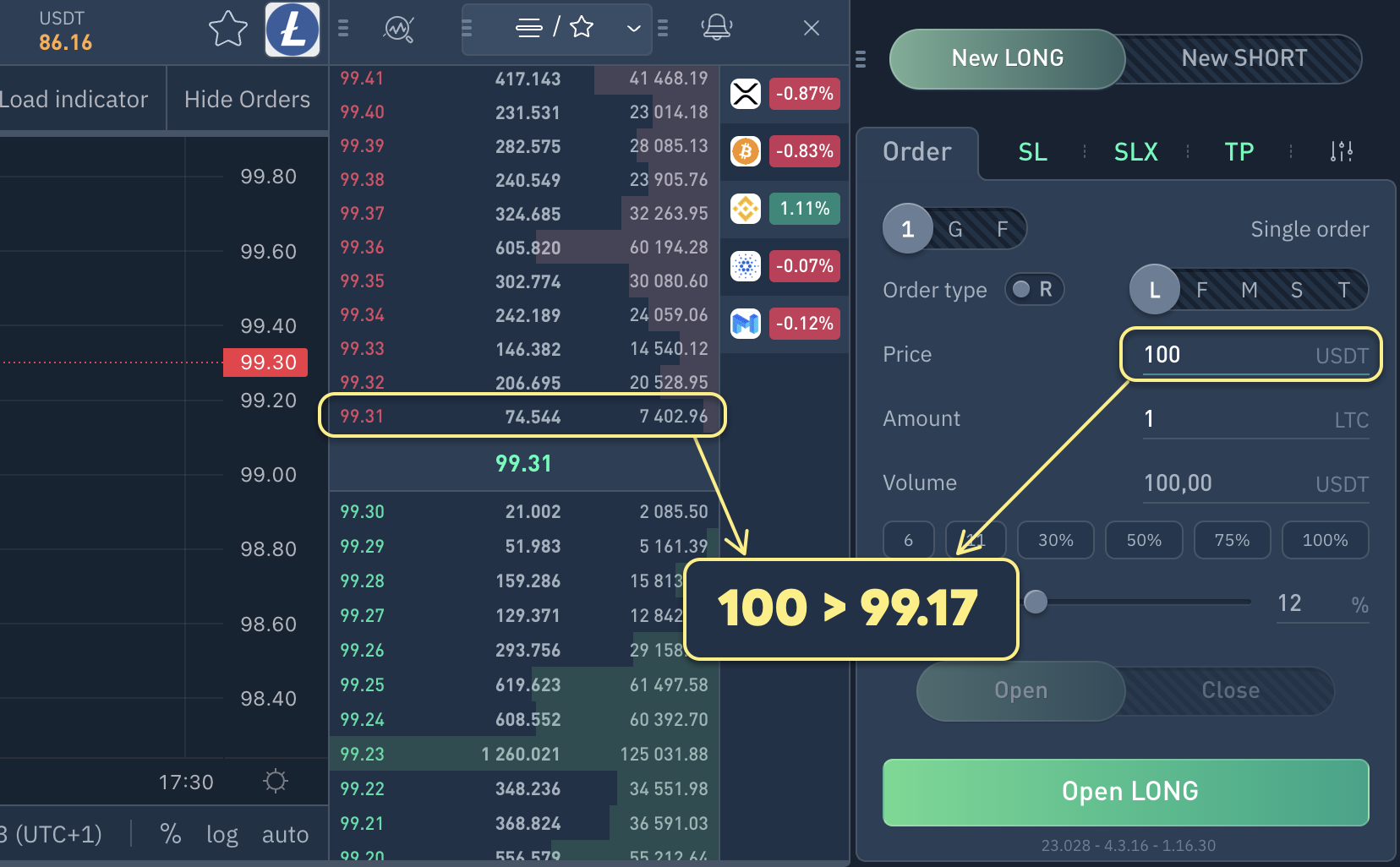
Precio de la orden **Inferior** al precio de <mark style="color:red;">**venta**</mark> más exterior de el libro de órdenes

<figure><img src="https://t24536365.p.clickup-attachments.com/t24536365/2c4891f8-07b8-4366-8a3e-0616ef3b9828/image.png" alt=""><figcaption></figcaption></figure>

### Vender&#x20;

Precio de la orden **Mayor** que el precio de <mark style="color:green;">**compra**</mark> extremo en el libro de órdenes​

<figure><img src="https://t24536365.p.clickup-attachments.com/t24536365/d2c36c45-6627-45c5-9f12-c5dbecbfe7d3/image.png" alt=""><figcaption></figcaption></figure>

## Condiciones para la ejecución de una Orden Límite de Mercado

### Comprar

Precio de la orden **Mayor** que el precio <mark style="color:red;">**de**</mark> <mark style="color:red;">**venta**</mark> más alejado en el libro de órdenes

<figure><img src="https://t24536365.p.clickup-attachments.com/t24536365/ee5ffa9c-b00a-4903-9552-c85604a439ec/image.png" alt=""><figcaption></figcaption></figure>

### Venta

Precio de la orden **Menor** que el último precio <mark style="color:green;">**de compra**</mark> en el libro de órdenes

<figure><img src="https://t24536365.p.clickup-attachments.com/t24536365/2955243f-364a-4ddb-ab3e-579d63ff3127/image.png" alt=""><figcaption></figcaption></figure>

**¿Tiene alguna duda? Podemos ayudarte en nuestro chat de Telegram.**

{% embed url="<https://t.me/finandyes>" %}


---

# Agent Instructions
This documentation is published with GitBook. GitBook is the documentation platform designed so that both humans and AI agents can read, navigate, and reason over technical content effectively. Learn more at gitbook.com.

## Querying This Documentation
If you need additional information that is not directly available in this page, you can query the documentation dynamically by asking a question.

Perform an HTTP GET request on the current page URL with the `ask` query parameter, and the optional `goal` query parameter:

```
GET https://docs.finandy.com/es/trading/create-order-grid/order-types/limit-order.md?ask=<question>&goal=<endgoal>
```

`ask` is the immediate question: it should be specific, self-contained, and written in natural language.
`goal` is optional and describes the broader end goal you are ultimately trying to accomplish on behalf of the user. GitBook uses it to tailor the answer towards what is most useful for that goal.

The response will contain a direct answer to the question and relevant excerpts and sources from the documentation.

Use this mechanism when the answer is not explicitly present in the current page, you need clarification or additional context, or you want to retrieve related documentation sections.