> For the complete documentation index, see [llms.txt](https://docs.finandy.com/llms.txt). Markdown versions of documentation pages are available by appending `.md` to page URLs; this page is available as [Markdown](https://docs.finandy.com/trading/create-order-grid/order-types.md).
# Order types
Terminal can create both real (exchange) and virtual orders, which place a real order based on trigger conditions.
### Real order
**R** (Real) - all exchange types + Floating orders
### Virtual order
**V** (virtual) - places an exchange order (Limit, Float, Market) when the trend hits a trigger price.
## Futures fees
### Maker fee = 0.02%
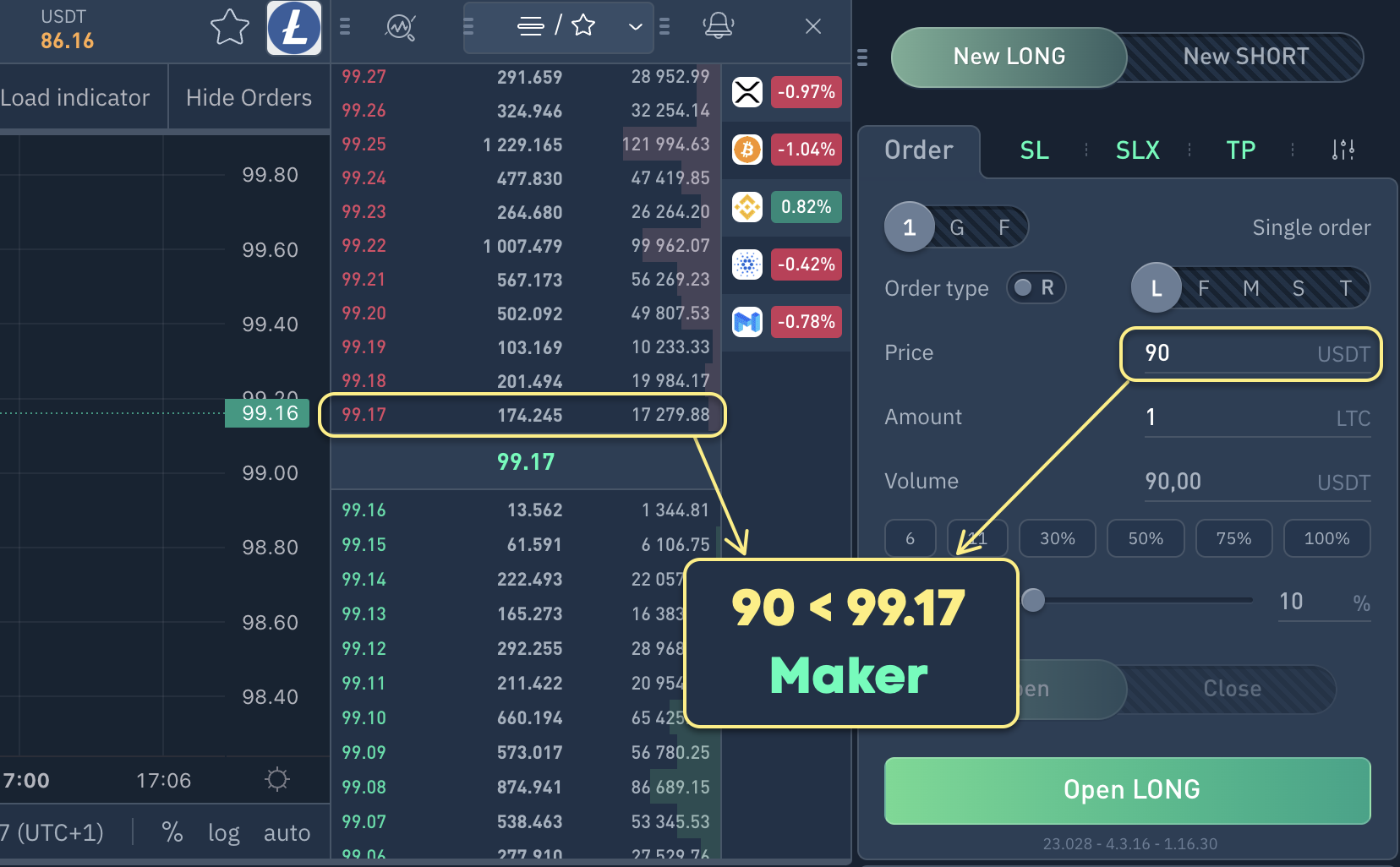
When executing a Limit order from the order book at a later time, the **Maker** commission is charged.
Example of using a Limit order to buy below the extreme selling price.
### Taker fee = 0.05%
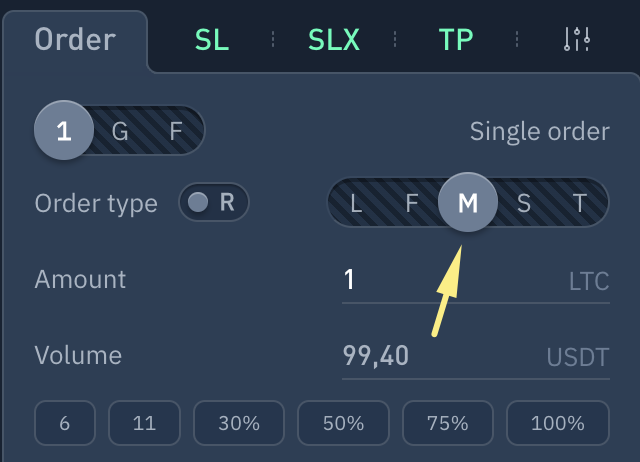
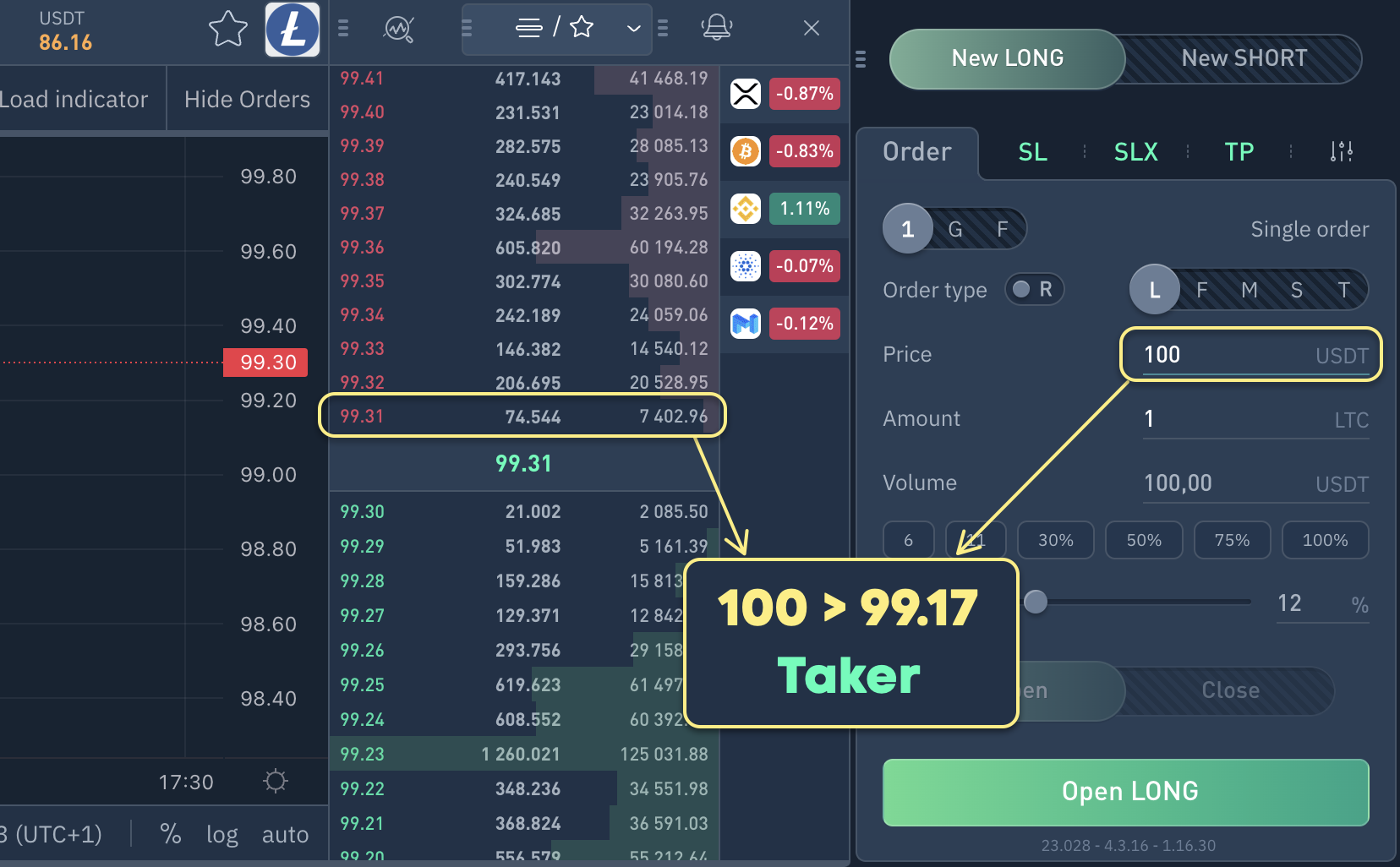
Taker fee is charged when orders are filled in the order book.
Examples:
1. Market order
2. In case a limit order (e.g. buy 100) is executed at market price due to the presence of an opposite direction order in the order book, the transaction will incur a **Taker** fee.
{% content-ref url="/pages/jv75T6F5wQ90mPIstSNi" %}
[Limit order](/trading/create-order-grid/order-types/limit-order.md)
{% endcontent-ref %}
{% content-ref url="/pages/gvrTMRW95UpQQTOhTssi" %}
[Floating order](/trading/create-order-grid/order-types/floating-order.md)
{% endcontent-ref %}
{% content-ref url="/pages/v3YrIMOkz0UBXefI1gMM" %}
[Market order](/trading/create-order-grid/order-types/market-order.md)
{% endcontent-ref %}
{% content-ref url="/pages/8BYGy0IoBb2HVwaD1LIn" %}
[Stop order](/trading/create-order-grid/order-types/stop-order.md)
{% endcontent-ref %}
{% content-ref url="/pages/w6quyXZwXWPoq9791kG9" %}
[Trailing order](/trading/create-order-grid/order-types/trailing-order.md)
{% endcontent-ref %}
{% content-ref url="/pages/sBnlfIgicPT9mSAJT4kW" %}
[Virtual order](/trading/create-order-grid/order-types/virtual-order.md)
{% endcontent-ref %}
---
# Agent Instructions
This documentation is published with GitBook. GitBook is the documentation platform designed so that both humans and AI agents can read, navigate, and reason over technical content effectively. Learn more at gitbook.com.
## Querying This Documentation
If you need additional information that is not directly available in this page, you can query the documentation dynamically by asking a question.
Perform an HTTP GET request on the current page URL with the `ask` query parameter, and the optional `goal` query parameter:
```
GET https://docs.finandy.com/trading/create-order-grid/order-types.md?ask=&goal=
```
`ask` is the immediate question: it should be specific, self-contained, and written in natural language.
`goal` is optional and describes the broader end goal you are ultimately trying to accomplish on behalf of the user. GitBook uses it to tailor the answer towards what is most useful for that goal.
The response will contain a direct answer to the question and relevant excerpts and sources from the documentation.
Use this mechanism when the answer is not explicitly present in the current page, you need clarification or additional context, or you want to retrieve related documentation sections.